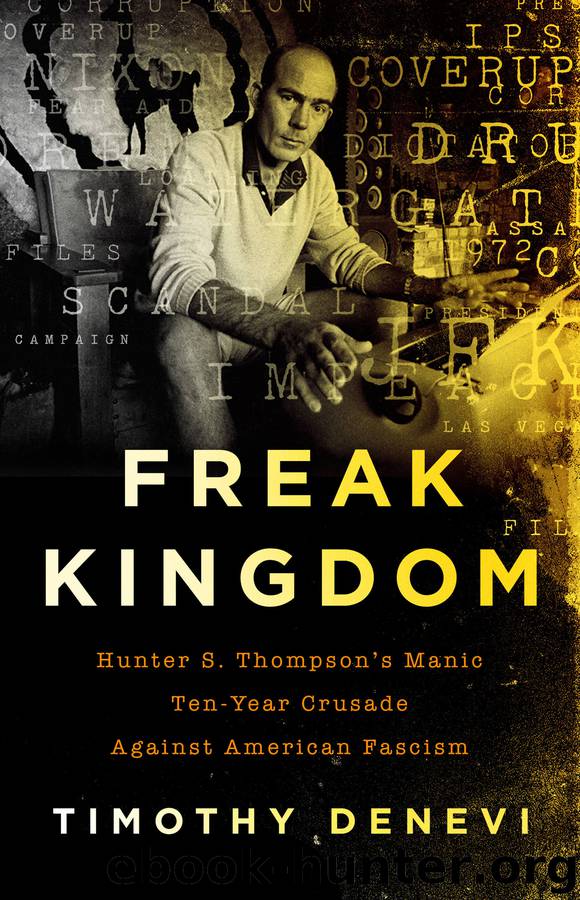
Freak Kingdom by Timothy Denevi
Author:Timothy Denevi
Language: eng
Format: epub
Publisher: PublicAffairs
Published: 2018-10-29T16:00:00+00:00
Thompson’s account of Ed Muskie’s Sunshine Special appeared as part of his political coverage in Rolling Stone no. 106. It immediately became a hit with his fellow correspondents, whose own publications would never allow them to chronicle the campaign in such a way.
In retrospect, the train narrative was a great way to characterize, to Rolling Stone’s youthful demographic, a candidate like Muskie: that consummate party hack who wasn’t all that different from his Republican counterparts. To anyone covering the campaign at that time—back during January and February, when Muskie’s poll numbers showed him ahead of Nixon in a possible general election face-off—it was clear that the frontrunner was, in reality, imploding. Which drove Thompson crazy; these reporters, hoping to retain access to the candidate (and worried about the scrutiny and pressure their editors might face), played it safe, rarely revealing to the electorate what was really going on. Thompson didn’t have to worry about any of that. From the start he and Wenner had conceived his literary/advocacy gig as a one-off thing.
About Muskie, Thompson would write: “He talked like a farmer with terminal cancer trying to borrow money on next year’s crop.” And: “Working for Big Ed was something like being locked in a rolling boxcar with a vicious 200-pound water rat. Some of his top staff people considered him dangerously unstable.” And: “Sending Muskie against Nixon would have been like sending a three-toed sloth out to seize turf from a wolverine… it was stone madness from the start to ever think about exposing him to the kind of bloodthirsty thugs that Nixon and John Mitchell would sic on him. They would have him screeching on his knees by sundown on Labor Day.”
He wrote this passage three months before the Watergate break-in—long before the full extent of Richard Nixon’s astonishing criminality had come to light—but then that was the point: to anyone who, like Hunter Thompson, had been watching Nixon carefully these last ten years, a “dirty trick” in the vein of breaking into your rival’s headquarters wasn’t a revelation. Of course the thirty-seventh president would do this and more to keep his hold on power. The real question: just how deep did it all go?
In the summer of 1971, after RAND employee Daniel Ellsberg blew the whistle on the top-secret Pentagon Papers, the administration had created and funded a secret unit within the existing Committee for the Re-Election of the President—“Plumbers,” they were called—to surveil, sabotage, and blackmail critics. They broke into the office of Ellsberg’s psychiatrist. They plotted a robbery/bombing of the Brookings Institution, where Nixon was worried that evidence of his treasonous interference in the 1968 election had been housed. “I want it implemented on a thievery basis!” the president had said to H. R. Haldeman, his chief of staff. That September he’d had White House counsel John Dean draw up an enemies’ list. And in January, when the senator from Maine emerged as the frontrunner, senior operative Donald Segretti cooked up what would later be called
Download
This site does not store any files on its server. We only index and link to content provided by other sites. Please contact the content providers to delete copyright contents if any and email us, we'll remove relevant links or contents immediately.
Fanny Burney by Claire Harman(26605)
Empire of the Sikhs by Patwant Singh(23089)
Out of India by Michael Foss(16856)
Leonardo da Vinci by Walter Isaacson(13339)
Small Great Things by Jodi Picoult(7151)
The Six Wives Of Henry VIII (WOMEN IN HISTORY) by Fraser Antonia(5518)
The Wind in My Hair by Masih Alinejad(5100)
A Higher Loyalty: Truth, Lies, and Leadership by James Comey(4965)
The Crown by Robert Lacey(4818)
The Lonely City by Olivia Laing(4804)
Millionaire: The Philanderer, Gambler, and Duelist Who Invented Modern Finance by Janet Gleeson(4481)
The Iron Duke by The Iron Duke(4365)
Papillon (English) by Henri Charrière(4277)
Sticky Fingers by Joe Hagan(4204)
Joan of Arc by Mary Gordon(4116)
Alive: The Story of the Andes Survivors by Piers Paul Read(4035)
Stalin by Stephen Kotkin(3971)
Aleister Crowley: The Biography by Tobias Churton(3642)
Ants Among Elephants by Sujatha Gidla(3468)
